Capability-based planning uses your business capabilities — not projects or org charts — as the lens for deciding where to invest. It keeps strategy connected to what the business actually does.
Capability-based planning uses what the business does — its capabilities — as the organising lens for investment decisions, instead of projects, budgets or org units.
The shift sounds subtle and changes the conversation completely. Instead of "should we fund this project?", the question becomes "how strong does this capability need to be, how strong is it now, and what is the cheapest way to close the gap?" Projects become one possible answer rather than the unit of decision.
Project-based planning has three structural weaknesses that capability-based planning avoids.
It hides duplication. Four programmes can each be independently justified while all four are building overlapping answers to the same capability gap. Nothing in a project-by-project review surfaces that; laying them over a capability map does so immediately.
It optimises locally. Each project is assessed on its own business case. The portfolio question — are we investing in the things that matter most? — never gets asked, because there is no shared frame to ask it in.
It is unstable. Projects and departments change constantly. Capabilities barely move. Planning against a stable frame means this year's analysis is still usable next year.
Getting executives to state a target level per capability is harder than assessing current state and more valuable. It forces an explicit decision about where the organisation intends to be merely adequate.
Most capabilities should target level 3 — defined and consistent. A small number that genuinely differentiate should target 4 or occasionally 5. Some commodity capabilities are perfectly acceptable at 2. A leadership team that says "level 5 across the board" has not engaged with the question, and it is worth pushing back, because a target everywhere is a priority nowhere.
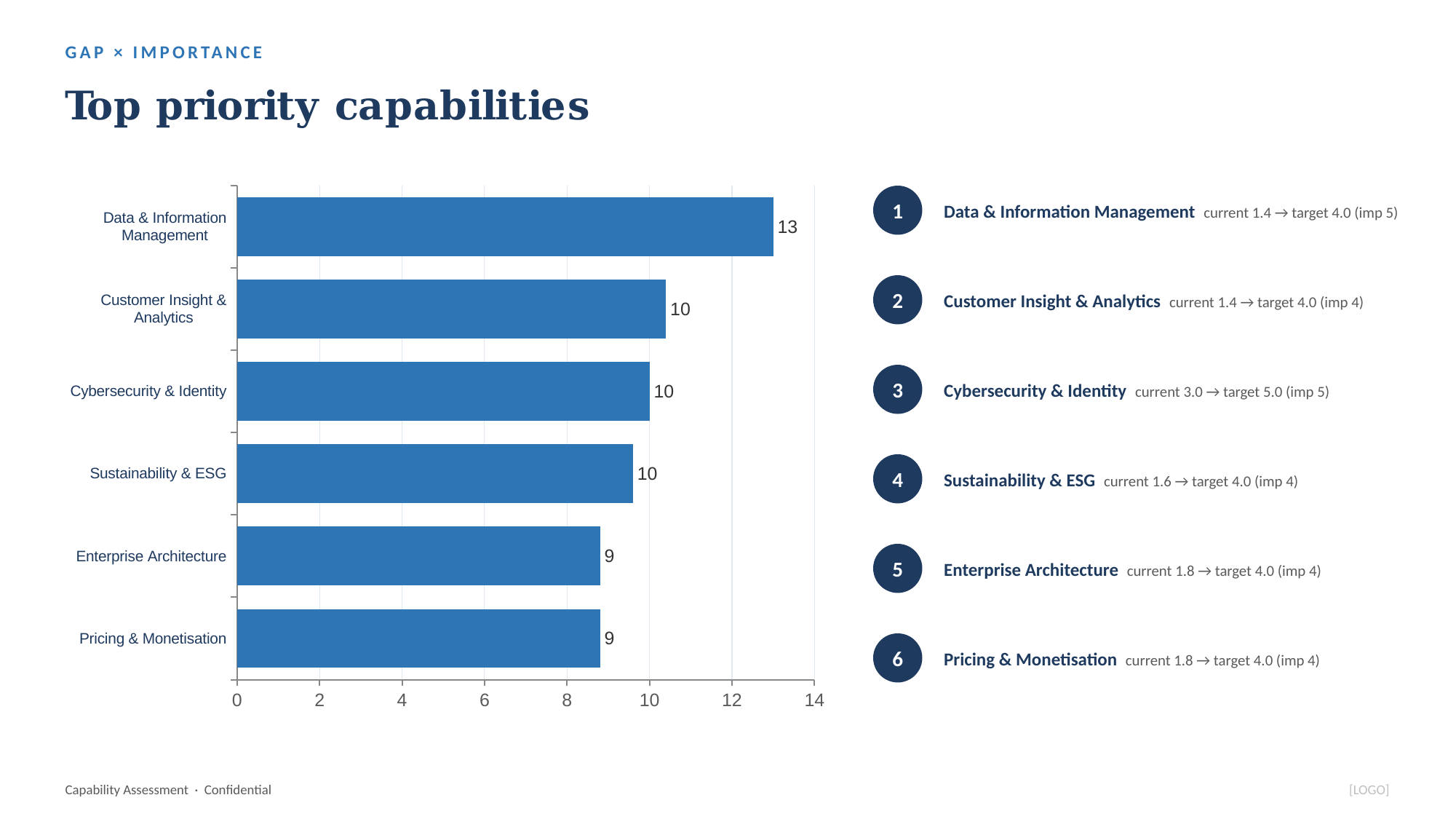
The output that lands with boards is a simple two-axis picture: gap size against strategic importance.
| Low importance | High importance | |
|---|---|---|
| Large gap | Accept. Weak, but it does not matter | Invest. This is the priority list |
| Small gap | Maintain. Do nothing | Protect. Already strong where it counts — do not let it slip |
The top-left quadrant is the one that changes conversations. Explicitly deciding to accept weakness in an unimportant capability releases attention and budget, and it gives executives permission to stop worrying about something they have been told is red for three years.
Three things change when planning is organised this way. Duplication becomes visible before it is funded rather than after. Investment discussion moves from advocacy — whoever argues best gets the money — to evidence. And the analysis persists, because next year you re-score against the same frame and can show movement rather than starting again.
The main cost is that it requires business engagement, particularly for the required-maturity step. An architecture team can produce a capability map and a current-state assessment alone; it cannot set targets alone. If you cannot get that engagement, you have a capability assessment rather than capability-based planning — still useful, but a different thing.
On presenting the result, see presenting a capability assessment to the board.
The Business Capability Assessment Toolkit gives you the maturity model, calculator and heatmaps to baseline capability and feed a capability-based plan.