A capability assessment is only as valuable as the decision it drives. Presenting it well to the board is what turns analysis into funded action.
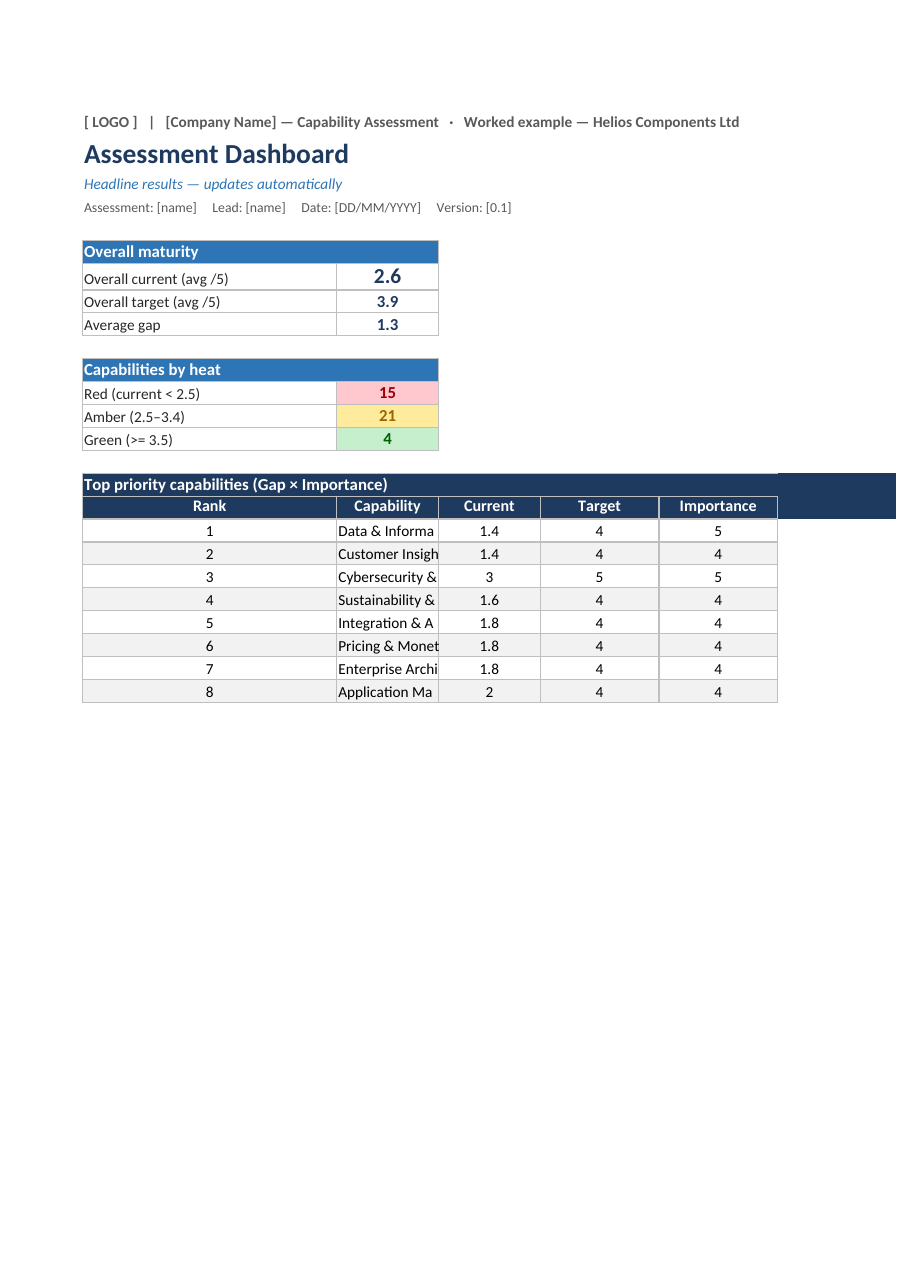
The most common way a good capability assessment fails is being presented as an assessment. Weeks of rigorous scoring get compressed into a heatmap, put on screen, and the room spends forty minutes arguing about whether procurement is really a 2.
Boards do not want your analysis. They want the decision your analysis supports. The heatmap is evidence for a recommendation; it is not the recommendation, and leading with it invites the audience to audit your method instead of engaging with your conclusion.
Open with the finding in one sentence. "Three of the five capabilities our growth strategy depends on are significantly below the level required, and two of them are unfunded." Everything after that is support.
One: the headline. What you found, in a sentence, with the two or three numbers that make it concrete. If the board reads nothing else, this is what they should leave with.
Two: the gap picture. Not raw maturity — the gap between where capabilities are and where the strategy needs them. Raw maturity invites "is that good?"; a gap against a target the executives themselves set does not. Plot gap against strategic importance so the priorities fall out visually.
Three: the priorities. Three to five capabilities, each with the gap, the business consequence of leaving it, and the indicative cost and time to close. Five is the practical maximum — a board that leaves with five priorities has been given a strategy, one that leaves with fifteen has been given a list.
Four: the ask. Precisely what you want them to decide today. Approve funding, endorse a sequence, assign owners. A presentation with no ask gets noted and filed.
Everything else goes in an appendix: the full scoring, the methodology, the interview list, the calibration approach. Have it ready and do not show it unless challenged.
This feels wrong to people who have done the work, and it is exactly right. Detail in the main deck signals that you want the audience to check your arithmetic. Detail in the appendix, produced instantly when questioned, signals rigour and control.
One caution: know your appendix well enough to reach any number in seconds. Being unable to substantiate a challenged score is far worse than never showing the detail.
A board that is shown five red capabilities feels criticised. A board that is shown three options with costs and consequences feels equipped.
Where possible, present each priority as a choice with a do-nothing baseline: invest this much and reach the required level in eighteen months, invest less and reach it in three years, or accept the current level and the specific exposure that carries. Boards make decisions readily when the alternatives and their consequences are visible; they defer when handed an undifferentiated problem.
Include the counterfactual explicitly. What this capability gap costs over three years if nothing changes is often the single most persuasive number in the pack.
"Is this score right?" Answer with evidence, not method. "We scored it 2 because there is no documented process, no named owner and no metric — here are the three things we looked for and did not find." Evidence ends the debate; describing your scoring scale extends it.
"This is just IT's view." Pre-empt it. Name who was interviewed and which business leaders validated the scores. If the assessment was done without business input, expect this challenge to land, because it is fair.
"Why this capability and not that one?" Come back to required maturity. You are prioritising by gap against a target the leadership team set, not by absolute weakness. This is why establishing target levels with executives beforehand matters so much — it makes the prioritisation theirs rather than yours.
Pre-brief the two or three people who will shape the discussion. A board meeting is a poor venue for anyone to encounter a surprising finding about their own area for the first time; surprise produces defensiveness, and defensiveness kills recommendations.
Walking the affected executives through their capability's score in advance turns potential opponents into people who have already absorbed the news and, often, into advocates. See the maturity model for making those scores defensible in the first place.
The Business Capability Assessment Toolkit includes an executive report template and a board-ready deck built to tell exactly this story.