Home/Resources/EA templates

Guide · Enterprise architecture

What's in a complete enterprise architecture toolkit

Search for “enterprise architecture templates” and you'll find endless loose documents. A genuinely useful toolkit is different — it's a connected system where every piece feeds the next.
The components of a complete enterprise architecture toolkit
A complete toolkit is a connected system, not a pile of templates.

More than templates

Search for enterprise architecture templates and you will find thousands of loose documents — a capability map here, a review checklist there, a maturity model from someone's slide deck. Individually they look useful. Assembled, they rarely produce anything, because each was designed in isolation and none of them connect.

The gap between a folder of templates and a working method is the connection between them. A capability model that feeds a scoring calculator whose output drives a heatmap and an executive deck is a system. The same four artefacts sourced separately, with different capability names and incompatible scales, is an afternoon of reconciliation before you can start.

What a complete toolkit includes

Whatever the domain, a toolkit that can actually be run has five layers. Missing any one of them is what turns a promising download into shelfware.

LayerWhat it doesWhat it looks like
MethodTells you the sequence and who to involveMethodology document, playbook, RACI
InstrumentsCollect the inputChecklists, questionnaires, question banks, interview guides
EngineTurns input into analysisScoring calculator, weighted scorecard, register with auto-scoring
OutputCommunicates the resultReport template, executive deck, heatmap, roadmap
Worked exampleShows what finished looks likeEvery template completed for a realistic case

The engine is what most free template collections lack, and it is where the real work is. Producing a capability map is a day; producing a scoring model that handles weighting, gaps, prioritisation and heatmap generation without breaking when you change the capability list is considerably harder.

Why the worked example matters most

The layer people underestimate is the completed example. A blank template tells you what fields exist; it does not tell you the standard of answer expected.

Faced with an empty NFR template, a competent architect will still write "high availability required" unless they have seen an example that says "99.9% monthly uptime excluding agreed maintenance, degraded read-only acceptable during failover". The example calibrates the depth. It is also the fastest way to judge whether a toolkit is any good before you commit time to it — if the worked example is thin, the method behind it is thin.

Why connection matters

Consider what actually happens across an assessment. The capability list defines the rows in the calculator. The question bank generates the evidence that produces the scores. The scores generate the heatmap. The heatmap and gap analysis populate the report and the executive deck.

When those come from one coherent set, changing a capability name propagates. When they come from five sources, you spend the first two days of a five-day assessment making the pieces agree — and the risk of a mismatch surviving into the board pack is real.

Editable and white-label

Two practical requirements that eliminate a surprising amount of what is available.

Editable formats. Word, Excel and PowerPoint you can genuinely change. A locked PDF is a reference, not a tool. If the scoring engine is a black box you cannot inspect, you cannot defend its output when an executive challenges it — and you will be challenged.

Licence that permits client work. Many template collections prohibit commercial use, which makes them useless to consultants and to internal teams working with partners. Check what you are allowed to do before you build a practice on something.

How to evaluate one

Four questions cut through most marketing. Does it include a completed worked example, or only blanks? Do the pieces reference each other, or are they independent files? Is there a working calculation engine, or only documents? And can you edit and use it commercially?

A toolkit that fails any of those will cost you more in assembly than it saves. For the underlying methods themselves, see the guides on capability assessment, application rationalisation, architecture review and governance.

See what a complete toolkit looks like

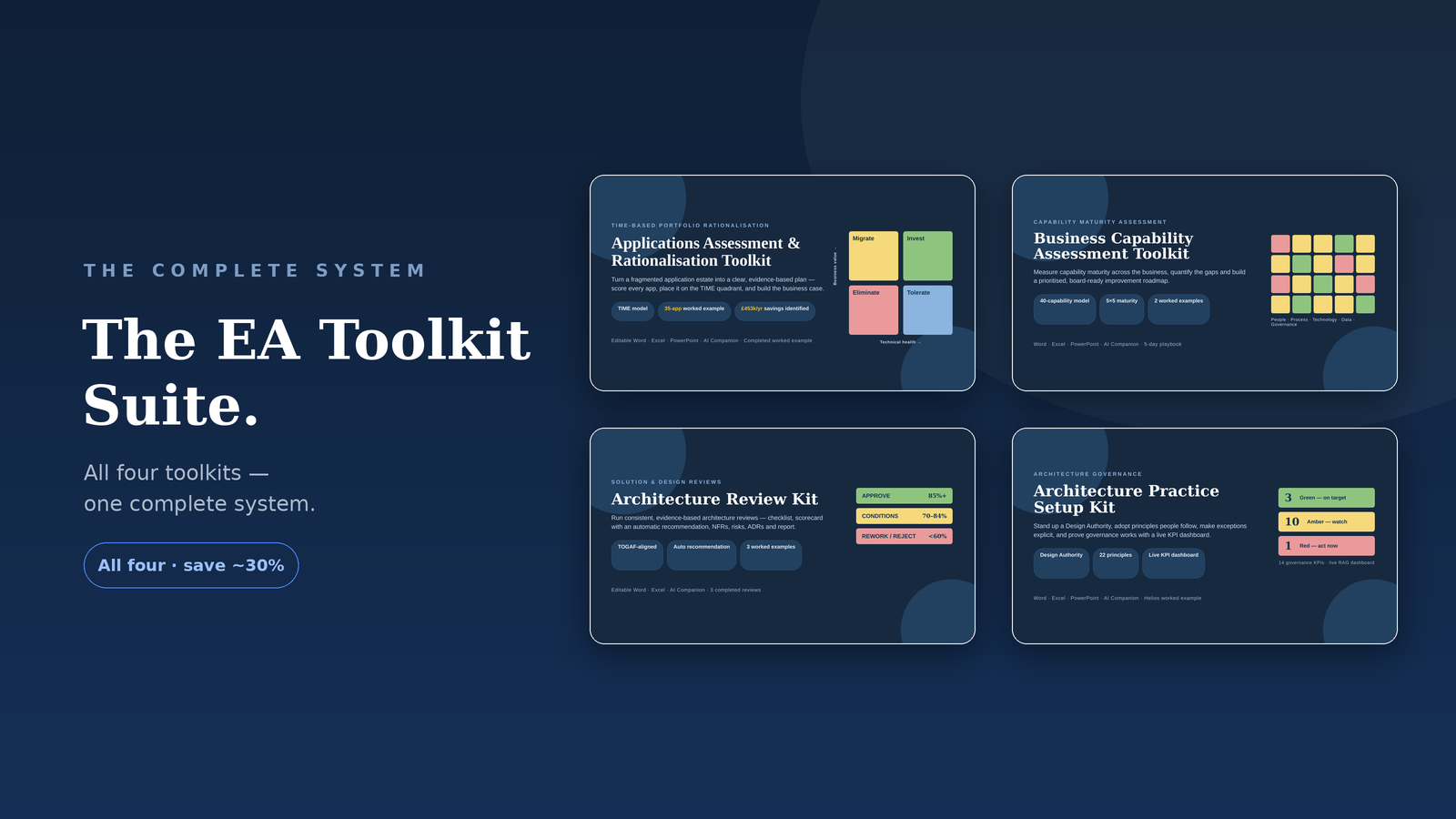
The EA Toolkit Suite bundles four connected toolkits — governance, capability assessment, application rationalisation and architecture review — each a complete method with worked examples.

View the suite →