Home/Resources/EA frameworks

Guide · Enterprise architecture

Enterprise architecture frameworks compared

There are several enterprise architecture frameworks, and teams often spend more time debating which to adopt than actually doing architecture. Here's a plain comparison — and a pragmatic way through.
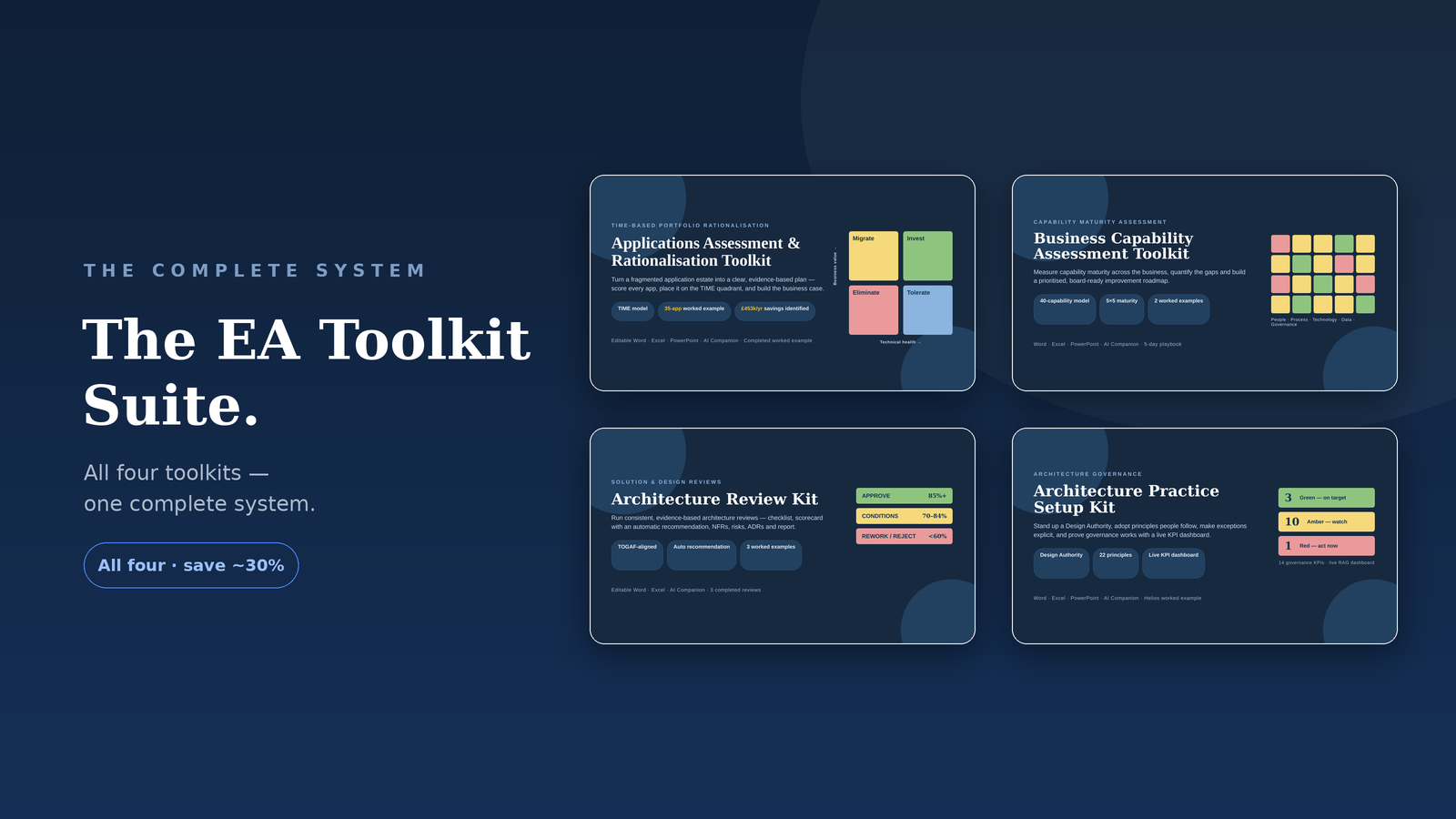
Enterprise architecture practices independent of any single framework
The methods matter more than the framework badge.

The frameworks people actually mean

When someone says "which EA framework should we use?", they are usually conflating three different kinds of thing. Separating them saves months of circular debate.

TOGAF

The most widely adopted. Its core is the Architecture Development Method (ADM) — a cycle running from architecture vision through business, data, application and technology architectures, then on to opportunities, migration planning, implementation governance and change management. Around that sit a content framework, a capability framework and guidance on governance.

TOGAF's real contribution is vocabulary and sequence. It gives a dispersed group of architects a shared language and an agreed order of operations. Its reputation for heaviness is mostly earned by organisations that attempt to adopt all of it rather than the 20% that fits.

Zachman

Not a method at all — a classification schema. A six-by-six grid crossing perspectives (executive, business management, architect, engineer, technician, enterprise) with questions (what, how, where, who, when, why). It tells you what kinds of artefact could exist and how they relate; it says nothing about how to produce them or in what order.

Zachman is genuinely useful as a completeness check — a way of noticing that you have modelled the "what" and "how" exhaustively and never once addressed "why". It is not something you can run a programme from.

Government frameworks

FEAF (US federal), DoDAF (US defence) and MODAF (UK defence, now largely folded into NAF) exist because those environments need standardised, comparable architecture descriptions across many independent agencies or suppliers. If you are not bidding into those environments, their prescriptiveness will cost you more than it returns.

ArchiMate — the one that is not a framework

ArchiMate is a modelling notation, not a framework. It defines symbols and relationships for expressing architecture across business, application and technology layers. You can use ArchiMate with TOGAF, with a homegrown method, or on its own. Confusing notation with method is one of the most common and most expensive category errors in this space.

What each one is actually for

ApproachWhat it gives youWhat it does not
TOGAFMethod, sequence, vocabulary, governance guidanceContent — you still supply the analysis
ZachmanCompleteness check, artefact taxonomyAny notion of how or when
FEAF / DoDAF / NAFStandardised, comparable descriptions across organisationsAgility; they assume scale and mandate
ArchiMateA precise way to draw what you have decidedAny guidance on deciding it

Framework, method and notation

A framework gives you structure and vocabulary. A method tells you what to do on Tuesday. A notation lets you write the answer down unambiguously. Most organisations adopt a framework, never define their methods, and then wonder why nothing changed.

The methods are where the work lives, and there are fewer of them than the framework literature implies. In practice an architecture function repeatedly does four things: it assesses where the business is strong and weak, it decides what to do with the application estate, it reviews whether a proposed solution is good enough, and it governs the decisions that result. Everything else is variation on those.

How to choose

Match the weight of the framework to the weight of your organisation and the pressure you are under.

What adopting TOGAF actually involves

The honest version: certification teaches vocabulary, not practice. A newly certified team still has to decide which ADM phases they will genuinely run, which artefacts they will genuinely maintain, and who has authority to say no. Those three decisions determine whether the adoption works, and none of them are in the standard.

Expect to formally use perhaps a third of the ADM, produce perhaps a dozen artefact types rather than the full content framework, and spend more time on governance mechanics — design authority, principles, exceptions — than on modelling.

The pragmatic path

Pick a framework as a reference shelf, not a programme. Then choose the two or three methods that address your organisation's actual pain, and run them to a consistent standard every single time. A team that reliably produces a defensible architecture review and a credible capability assessment will be trusted far sooner than one that has documented its metamodel.

Consistency beats comprehensiveness. The framework is a means; the methods are the work.

Three mistakes worth avoiding

  1. Adopting a framework before you have a customer. If no executive is waiting on an architecture answer, framework selection is displacement activity.
  2. Treating certification as capability. A certified team with no agreed decision rights has vocabulary and no authority.
  3. Modelling ahead of demand. Every artefact you create is one you must maintain. Produce them when a decision needs them, not because the content framework lists them.

Run the methods, not just the framework

The EA Toolkit Suite gives you the four core practices — governance, capability assessment, application rationalisation and architecture review — as ready-to-run, editable toolkits.
View the suite →