Most organisations run far more applications than they need. Application rationalisation is how you decide, with evidence, which ones to keep, invest in, replace or switch off — and the TIME model is the framework that makes those decisions defensible.
Application rationalisation (sometimes spelled "rationalization", or called application portfolio rationalisation) is the process of reviewing every application in your estate and deciding what to do with it — to cut cost and complexity, remove duplication, and free budget to invest where it matters.
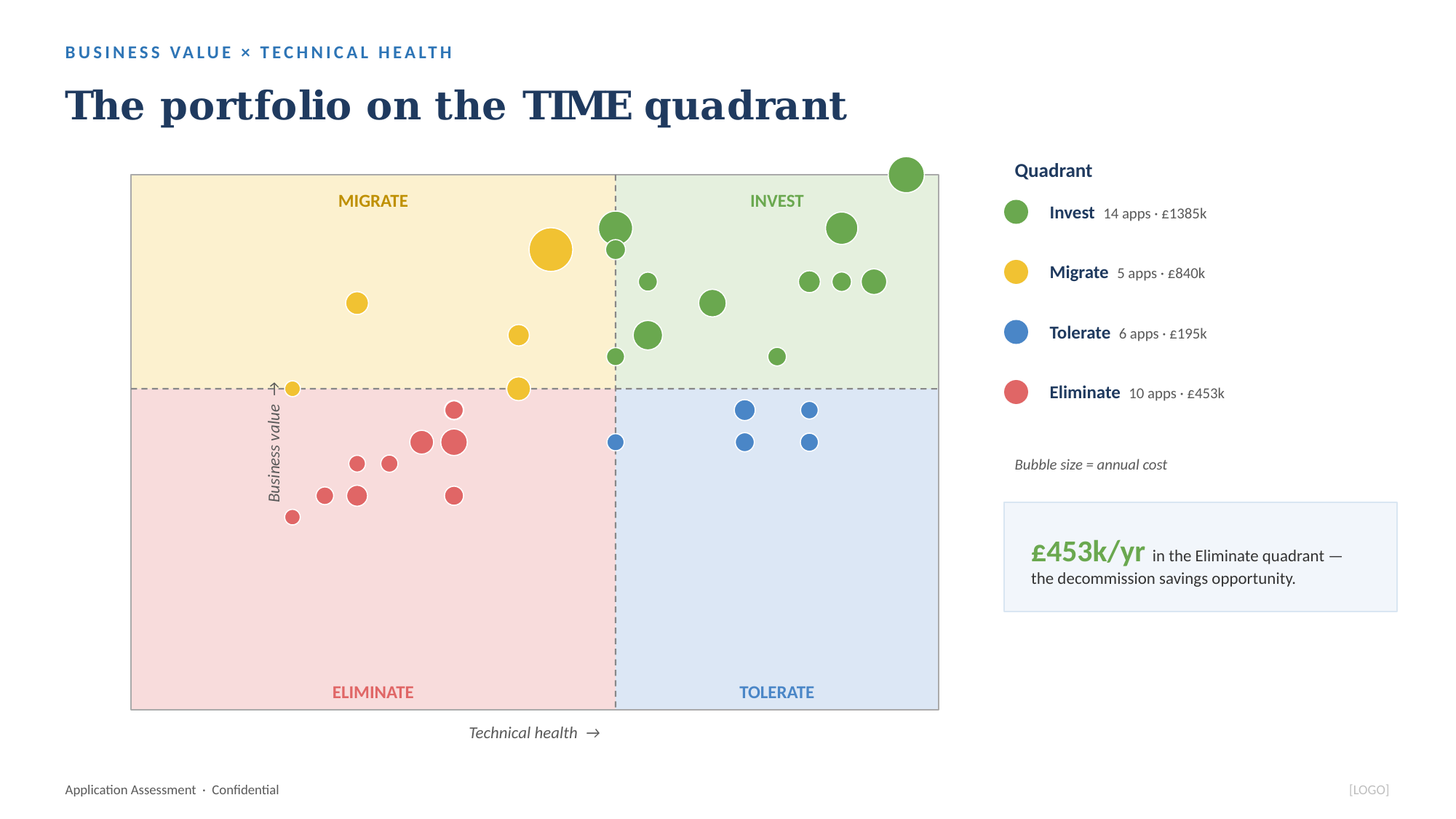
The TIME model sorts each application into one of four quadrants based on business value and technical health:
Business value reflects how important the app is — process criticality, users, and the cost of losing it. Technical health reflects supportability, stability, security and the age of the technology. A simple 1–5 scale on each axis keeps scoring consistent across hundreds of applications.
Efforts stall when scoring is subjective, when the analysis never connects to cost, or when the output is a spreadsheet nobody can act on. Use a consistent model, follow the money, and finish with an executive-ready roadmap.
The Applications Assessment & Rationalisation Toolkit gives you the scoring model, a calculator that auto-plots the TIME quadrant, a duplication workbook, an executive report and deck, and a completed 35-app worked example.